So Real Estate – तपाईंको भरपर्दो साथी 🤝
Planning to build your own house in Nepal? Here is a simple, easy-to-read guide with real numbers — material price, labor cost, permit fee, and hidden costs — so you can plan your budget the right way.
Quick Answer: How Much Does It Cost to Build a House in Nepal?
In 2026, building a house in Nepal costs between NPR 3,000 and NPR 6,500 per square foot. The exact price depends on:
- The finishing level you choose (basic, standard, or premium)
- The city or place where you build
- Material and labor prices at that time
Simple example: A normal 1,500 sq ft house in Kathmandu or Lalitpur costs around NPR 80 lakh to NPR 1.2 crore to build. This is only for the structure and basic finishing. It does not include land price, furniture, boundary wall, or utility connections.
This guide will explain the full cost, per square foot rate, material price, labor rate, permit fee, and the hidden costs many people forget.
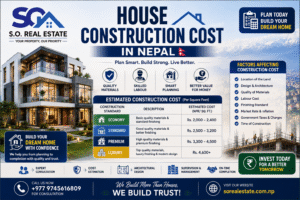
House Construction Cost Per Square Foot (Finish-wise)
| Finish Type | Price Per Sq Ft (NPR) | What You Get |
|---|---|---|
| Basic | 3,500 – 4,500 | Simple design, local materials, basic fittings |
| Standard | 4,500 – 5,500 | Good tiles, branded paint, decent kitchen and bathroom |
| Premium | 5,500 – 6,500+ | Imported tiles, custom wood work, high-end kitchen and bathroom |
Kathmandu Valley is usually on the higher side. Smaller cities and Terai areas are usually cheaper. Also remember: construction cost goes up around 7 to 10 percent every year, so these numbers are a guide for now, not a fixed price forever.
What Does the Per Square Foot Rate Actually Cover?
Many first-time house builders think the quoted rate covers everything. It does not.
The per square foot price usually includes:
- Foundation
- Columns, beams, and slabs
- Brick or block walls
- Plastering
- An agreed finishing package
But the “finishing package” is different for every contractor. One contractor’s “standard” package may mean simple tiles and basic bathroom fittings. Another contractor’s “standard” may mean better tiles and branded fittings. Always ask for a written scope of work before signing any agreement.
What the Rate Usually Does NOT Include
- Land price
- Boundary wall / compound wall and main gate
- Naksha pass (building permit) fee and soil testing
- Interior design, modular kitchen, wardrobes (beyond the basic package)
- Furniture and home appliances
- Electricity meter, water line, and drainage connection charges
- Landscaping and parking area
Tip: The gap between “structure cost” and actual “move-in ready cost” is usually 15 to 25 percent more. Plan for this in your budget.
House Construction Cost by Size (Kathmandu Valley)
| House Size | Finish Level | Estimated Structure Cost (NPR) |
|---|---|---|
| 800 sq ft | Standard | 40 lakh – 48 lakh |
| 1,200 sq ft | Good | 58 lakh – 72 lakh |
| 1,500 sq ft | Standard to Good | 72 lakh – 90 lakh |
| 1,600 sq ft | Premium | 90 lakh – 1.05 crore+ |
These numbers are for Kathmandu Valley. If you build in cities like Butwal, Bharatpur, or Dharan, labor and transport cost is usually 10 to 20 percent lower. But if you build in a remote hill area, cost can go 15 to 30 percent higher because it is harder to carry materials there.
What Makes House Construction Cost Go Up or Down?
Two houses of the same size can have a 40 percent or more price difference. Here is why:
1. Location
Location matters a lot after finishing quality. Building inside Kathmandu can cost around 20 percent more than building in a smaller city. This is because of higher labor rates, transport cost, and permit fees. Areas near Ring Road or inner city can also be difficult for trucks to enter, which adds extra cost.
2. Finishing Quality
The basic structure (foundation, frame, slab) does not change much in price between a basic house and a premium house. The finishing is where the price changes the most. Tiles, paint, doors, windows, kitchen, and bathroom fittings can double your per square foot rate. This is the part where you have the most control over your budget.
3. Soil and Foundation Type
If your land has soft or filled soil, you may need a stronger or deeper foundation. A small soil test cost now can save you from big foundation problems later. Always get soil testing done before construction.
4. Design Complexity
A simple, box-shaped house is cheaper to build than a house with many corners, curves, or split levels. Every extra design detail adds more labor, material, and time. If your budget is tight, choose a simple design.
5. Timing and Season
Steel and cement prices change during the year, often going up before the main building season. If you buy in bulk at the right time and fix a price with your supplier early, you can avoid price jumps in the middle of your project.
Current Material Prices in Nepal (2026)
Materials usually make up 55 to 65 percent of your total construction cost. Prices change often, so always confirm with your local supplier before finalizing your budget.
- Cement: NPR 600 – 1,100 per 50 kg bag. OPC type is around NPR 700–950. PPC type is cheaper, around NPR 600–850. Rural areas are usually a bit more expensive due to transport.
- Steel (TMT rebar): NPR 88 – 120 per kg, depending on brand, grade, and thickness. This is one of the most price-sensitive items in your whole project.
- Bricks, sand, and aggregate (gravel): Prices vary a lot depending on the source and distance. Sand and aggregate cost more if the quarry is far from your construction site.
Since steel and cement are big-ticket items, even a small price rise can add lakhs to your total cost. Keep a close watch on these two.
Labor Cost in Nepal
Labor is the second biggest part of your construction budget. Skilled labor rates have increased in recent years, partly because many young workers have gone abroad for jobs.
- Skilled mason in Kathmandu: around NPR 1,500 – 2,000 per day
- Skilled mason in Pokhara or Dharan: around NPR 1,200 – 1,500 per day
Three Ways to Hire Labor
- Daily wage – You control the work directly, but you must supervise every day.
- Per square foot labor contract – Easier to manage, but you still buy materials yourself.
- Turnkey contract – Contractor manages both labor and materials. Most hands-off option, but costs more. Always check the contractor’s past work and references before signing.
Naksha Pass and Permit Cost
You cannot legally build a house without a naksha pass (building permit) from your local municipality.
In Kathmandu and other big cities, permits are processed through the Electronic Building Permit System (eBPS), an online system where you can submit drawings and track your application status.
Documents Needed for Naksha Pass
- Approved architectural drawings
- Land ownership certificate (lalpurja)
- Soil test report
- NBC-compliant structural drawings
After you submit your application, the ward office puts up a public notice. Neighbors get 15 days to raise any objection about your planned construction.
Permit Fee
Budget around NPR 10 – 80 per square foot for the naksha pass fee. For a large house in Kathmandu Metropolitan City, the total permit cost can go above NPR 80,000. Every municipality sets its own rate, so confirm with your local ward office.
Important: NBC 105:2020 Seismic Code
Nepal’s earthquake-resistant building code, NBC 105:2020, is compulsory for all residential buildings, especially in city areas. If your house does not follow this code, the municipality will not give you a completion certificate. Always work with a licensed engineer from the very beginning to make sure your house is earthquake-safe.
Hidden and Forgotten Costs
Many people forget these costs while making their first budget:
- Soil testing – small cost now, saves you from foundation problems later
- Boundary wall and gate – often forgotten, can cost several lakh depending on plot size
- Utility connections – electricity meter, water line, and drainage each have separate charges and waiting time
- Design and engineering fees – architect and structural engineer fees are separate from construction cost
- Interior work – modular kitchen, wardrobes, false ceiling, and lighting add up quickly
- Price escalation – since prices rise 7 to 10 percent yearly, a project that takes two years will cost more than your first estimate
Keep a contingency fund of 10 to 15 percent of your total budget. Something unexpected always comes up during construction, and this buffer will protect you from financial stress.
How to Plan a Realistic House Construction Budget
- Decide the actual built-up area you need — not the biggest house you can imagine.
- Multiply that area by the per square foot rate for your chosen finish level.
- Add separate budget lines for: land (if not bought yet), permit fee, boundary wall, utility connections, design fee, interior work, and contingency fund.
- If you plan to use a home loan, check your loan eligibility early, since the amount you qualify for will affect how big a house you can plan.
- If your budget is tight, build in phases — many Nepali families build the main structure first, move in, and complete the top floor or interior later.
Frequently Asked Questions (FAQs)
How much does it cost to build a house in Nepal in 2026?
Most houses cost between NPR 3,000 and NPR 6,500 per square foot for structure and finishing. A standard 1,500 sq ft house in Kathmandu Valley costs roughly NPR 80 lakh to 1.2 crore, not including land, furniture, or utility connections.
Is it cheaper to build in Kathmandu or outside the Valley?
Building outside the Valley is usually cheaper. Labor and transport costs in Kathmandu can be about 20 percent higher than cities like Butwal or Dharan. However, remote hill areas can cost more because carrying materials there is difficult.
What is the biggest cost when building a house?
Materials are the biggest cost, usually 55 to 65 percent of the total, with steel and cement being the most important items to track. Labor cost comes next. Your finishing choices are where you have the most control over the budget.
Do I need a naksha pass to build a house?
Yes. You cannot legally build a house without a building permit from your municipality. In Kathmandu and other cities, you apply through the online eBPS system, and your design must follow the NBC 105:2020 seismic code.
How much contingency fund should I keep?
Plan for 10 to 15 percent of your total budget as a buffer. Prices rise during long projects, and unexpected costs almost always appear.
Can I build my house in phases?
Yes, many families do this. A common method is to complete the main structure and one or two floors first, move in, and finish the rest later as money becomes available.
Planning to Build or Buy a Home?
Building your own house gives you full control over design and budget, but it also means managing permits, labor, materials, and time. If you are still deciding between building and buying, it helps to know current property prices in your target area first.
Browse verified land and property listings on SO Real Estate to compare plot prices across Kathmandu, Lalitpur, Bhaktapur, and other cities — or list your property with us if you are ready to sell.
So Real Estate – तपाईंको भरपर्दो साथी 🤝
Note: The figures in this article are market estimates for 2026 based on the Nepali construction industry. Material rates, labor charges, and permit fees change over time and vary by location. Please confirm current prices with your local supplier, a licensed engineer, and your municipality before finalizing your construction budget.